

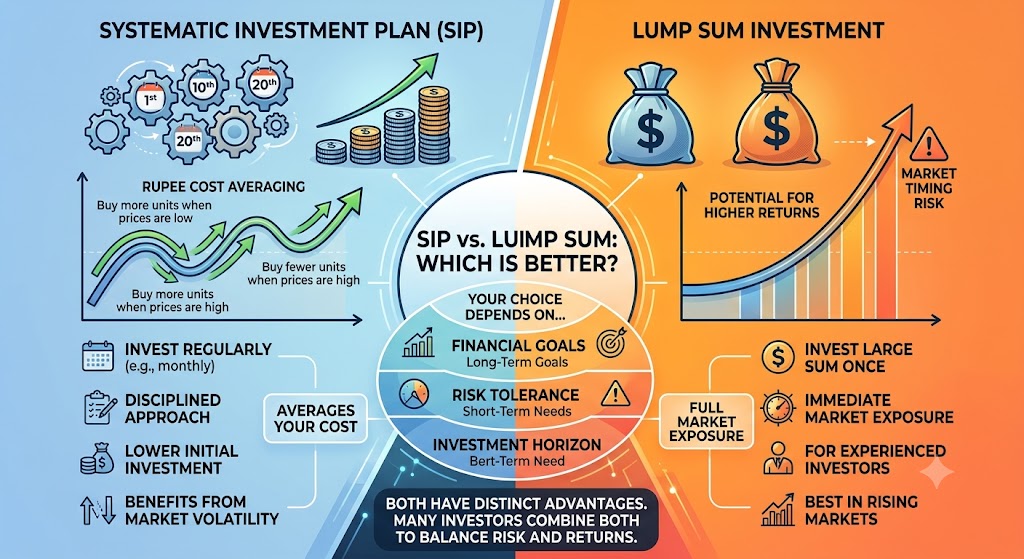
Investing in mutual funds often starts with a simple question: Should I invest through a Systematic Investment Plan (SIP) or make a lump sum investment? For investors in Thane, this decision can become particularly important when planning for long-term goals such as retirement, children’s education, wealth creation or buying a home. Both SIP and lump sum investing are widely used ways to invest in mutual funds, but they work differently and may suit different financial situations.
A SIP allows an investor to invest a fixed amount at regular intervals, usually every month, while a lump sum investment involves putting a larger amount into a mutual fund at one time. Neither method is automatically better for every investor. The more appropriate approach depends on factors such as available capital, monthly cash flow, investment horizon, financial goals, risk tolerance and market conditions. Investors considering mutual fund investments in Thane should therefore look beyond the simple SIP vs lump sum comparison and understand how each approach fits into their overall financial plan.
What Is SIP Investment?
A Systematic Investment Plan, commonly known as SIP, is a method of investing a predetermined amount into a mutual fund at regular intervals. For example, an investor may decide to invest ₹10,000 every month through a SIP. Instead of investing a large amount at one time, the investor gradually puts money into the selected mutual fund over a period of months or years.
One of the main advantages of SIP is that it can make investing more structured. Someone with a regular salary or business income can allocate a portion of their monthly surplus towards investments. Over time, these regular contributions can become an important part of a long-term financial strategy. This makes SIP particularly relevant for investors who want to build investment discipline without waiting until they accumulate a large amount of money.
For professionals, business owners and families in Thane, SIP investment can be connected to specific financial objectives. An investor may, for example, allocate a monthly amount towards retirement planning while maintaining separate investments for children’s education or other long-term goals. The amount invested should be determined according to the investor’s income, expenses, existing investments and financial objectives rather than choosing an amount simply because it is commonly recommended.
What Is Lump Sum Investment?
A lump sum investment is different because a larger amount is invested at one time instead of being divided into regular contributions. This can be useful for investors who already have significant capital available for investment. The money could come from accumulated savings, a bonus, maturity proceeds from another investment, business income or the sale of an asset.
For example, an investor who has ₹5 lakh available for long-term investment may decide to invest the amount in a suitable mutual fund rather than investing only through a monthly SIP. The investment, however, should be considered in the context of the person’s overall financial position. Money required for near-term expenses or emergency requirements should not automatically be invested in market-linked products simply because it is currently available.
Lump sum investing also means that a larger portion of the investor’s capital is exposed to the market from the chosen investment date. If markets perform favourably after the investment, the investor participates with the full amount from the beginning. If markets decline after the investment, the value of the investment can also fall. This makes asset allocation, investment horizon and risk tolerance important considerations when evaluating a lump sum strategy.
SIP vs Lump Sum: What Is the Difference?
The fundamental difference between SIP and lump sum investing is the timing of the investment. With SIP, the investor enters the market through multiple investments made over a period of time. With lump sum investing, a larger amount enters the market at one time. This difference can influence how the investor experiences market volatility.
Consider an investor with ₹6 lakh available for investment. The investor could potentially invest the entire ₹6 lakh at one time or spread the amount over a period through regular investments. If the market rises after a lump sum investment, the investor benefits because the entire amount was invested from the beginning. If the market falls soon after the investment, however, the entire amount is affected by that decline.
With a SIP approach, the same investor could invest ₹50,000 every month for 12 months. Each instalment would be invested at the prevailing market level. When prices are lower, the same amount can purchase more units, while higher prices generally result in fewer units being purchased. This is one of the characteristics of regular investing and is often referred to as rupee-cost averaging. However, investors should understand that SIP does not guarantee profits or eliminate market risk.
| Factor | SIP Investment | Lump Sum Investment |
| Investment pattern | Regular investments | One-time investment |
| Typical source of funds | Monthly income or surplus | Existing capital or accumulated savings |
| Market entry | Multiple entry points | Primarily one entry point |
| Investment discipline | Encourages regular investing | Requires larger initial allocation |
| Suitable situation | Regular cash flow | Significant capital already available |
| Market risk | Spread across investment dates | Larger exposure from investment date |
SIP vs Lump Sum Example for a Thane Investor
Suppose two investors each have access to ₹6 lakh and both intend to invest for the long term. The first investor decides to invest ₹50,000 every month for 12 months. The second investor invests the entire ₹6 lakh at the beginning.
The SIP investor’s money enters the market at different points during the year. If the market experiences fluctuations, some instalments may purchase more mutual fund units and others may purchase fewer. The investor therefore does not depend entirely on the market level on a single investment date.
The lump sum investor, on the other hand, has the full ₹6 lakh invested from the beginning. If the market performs well following the investment, the investor benefits from having the full capital invested earlier. If the market declines, the full investment is exposed to that decline. This does not mean that SIP is always superior or that lump sum investing is always riskier in every circumstance. The eventual outcome depends on market performance, investment duration and the specific investment selected.
Is SIP Better Than Lump Sum Investment in 2026?
There is no reliable way to say that SIP will always be better than lump sum investment simply because it is 2026. Investment decisions should not be based solely on predictions about whether the market will rise or fall during a particular year. Instead, investors should consider their personal financial circumstances and the purpose for which the money is being invested.
For an investor earning a regular monthly income in Thane, SIP may be a convenient way to invest consistently without waiting to accumulate a large amount. It can also help investors maintain discipline during periods when markets are volatile because the investment continues according to a predetermined schedule. On the other hand, an investor who already has a substantial amount of capital and a long investment horizon may need to evaluate how that capital should be deployed rather than automatically converting it into a monthly SIP.
The important consideration is therefore not whether SIP or lump sum is universally better, but which method is appropriate for the investor’s available funds, investment objective and risk profile.
What About SIP vs Lump Sum Investment in 2027?
The same principle applies when looking ahead to 2027. Investors may be tempted to delay investing while waiting for a market correction or a particular level of the market. Predicting the exact timing of market movements, however, can be difficult. A better approach is usually to establish an investment strategy based on clearly defined goals and an appropriate time horizon.
Someone starting a long-term investment programme from their monthly income may find SIP convenient in 2027 just as they would in 2026. Similarly, someone who receives a substantial amount of investable capital may need to consider a lump sum strategy or another suitable method of deployment. The decision should be based on the investor’s circumstances rather than the calendar year alone.
When Can SIP Be a Practical Choice?
SIP can be particularly practical for investors who receive regular monthly income and want to allocate a portion of that income towards long-term investments. Instead of waiting until a large amount is accumulated, the investor can start with an amount that fits within their monthly financial plan. This can make investing more consistent and easier to integrate with household expenses and other financial commitments.
SIP can also be useful when an investor has long-term financial goals. Retirement planning, children’s future education and long-term wealth creation are examples where regular investment contributions may form part of a broader strategy. The appropriate SIP amount and mutual fund selection should still be evaluated based on the investor’s individual circumstances.
When Can Lump Sum Investment Be Considered?
Lump sum investing may be relevant when an investor has a substantial amount of money already available for investment. This could include funds received from an investment maturity, annual bonus, business income, sale of an asset or accumulated savings. Instead of leaving the capital unallocated, an investor may consider how it can be incorporated into an appropriate long-term investment strategy.
However, having a large amount of money available does not automatically mean that the entire amount should be invested immediately. The investor should first consider emergency requirements, existing asset allocation, near-term financial commitments and risk capacity. Depending on the circumstances, an investor may evaluate different ways of deploying the available capital.
Can You Combine SIP and Lump Sum Investments?
Investors do not necessarily have to choose one method exclusively. SIP and lump sum investments can potentially form part of the same overall investment strategy.
For example, an investor may have a substantial amount of existing savings while also earning a regular monthly income. The existing capital and future monthly surplus can be evaluated separately as part of the investor’s broader financial plan. The objective is to determine an investment approach that aligns with the investor’s goals rather than choosing a method simply because it is considered popular.
This is particularly relevant when financial planning involves several goals with different time horizons. Money intended for a near-term requirement may need a different approach from money being invested for a retirement goal several years or decades away.
How Should Thane Investors Choose Between SIP and Lump Sum?
A practical decision starts with understanding where the money is coming from and what the investment is intended to achieve. A salaried professional with a predictable monthly income and limited initial capital may find SIP easier to incorporate into their financial routine. An entrepreneur or investor with significant available capital may have a different set of considerations.
The investment horizon is equally important. Money required in the short term should generally be evaluated differently from money that can remain invested for many years. Risk tolerance and the ability to handle temporary market declines should also be considered. An investor who becomes uncomfortable with normal market fluctuations may need a different strategy from someone who is comfortable remaining invested through market cycles.
This is why a conversation with a Mutual Fund Advisor in Thane can be useful when the decision is not simply about choosing an investment product. A professional discussion can help an investor look at SIP and lump sum investments in relation to their overall financial objectives, existing investments, cash flow and risk profile.
Choosing Mutual Funds for SIP or Lump Sum Investment
The SIP vs lump sum decision is only one part of mutual fund investing. Investors also need to consider the type of mutual fund being selected and whether it is appropriate for their investment objective and risk tolerance. Equity funds, debt funds, hybrid funds and other mutual fund categories have different characteristics and may be appropriate for different types of goals and investors.
Factors such as investment objective, asset allocation, portfolio composition, risk level, investment horizon, costs and the investor’s existing portfolio may need to be considered before making a decision. Historical performance can provide useful information about how a fund has behaved in the past, but it should not be treated as a guarantee of future performance.
Investors should also avoid selecting mutual funds purely because they have recently delivered high returns. A suitable investment should be evaluated within the context of the investor’s complete financial plan.
How Can a Mutual Fund Advisor in Thane Help?
For investors who are unsure about how much to invest, which mutual fund category to consider or whether SIP or lump sum is more appropriate, professional guidance can make the decision more structured. A Mutual Fund Advisor in Thane can help investors evaluate their financial goals, existing investments, investment horizon and risk profile before considering suitable investment options.
At GD Prime Wealth, investors can explore professional guidance for mutual funds and SIP investments based on their individual financial requirements. The focus should not simply be on starting an SIP or investing a lump sum, but on understanding how the investment fits into a wider financial strategy.
For investors looking for SIP Investment Services in Thane, the Mutual Funds & SIP service page provides more information about the investment services offered by GD Prime Wealth.
SIP vs Lump Sum: Which Is Better for You?
The answer depends on your financial situation. SIP can be a practical approach for investors who have regular monthly income and want to invest progressively over time. Lump sum investment may be worth considering when a significant amount of capital is already available and the investor has a suitable investment horizon and risk capacity.
In some situations, a combination of regular SIP investments and an appropriate strategy for existing capital may also be considered. There is no universal investment method that works equally well for every person.
For Thane investors planning their investments for 2026 and 2027, the more important question is therefore not simply “SIP vs lump sum—which is better?” but rather “Which investment approach is appropriate for my financial goals, available capital, cash flow, investment horizon and risk profile?”
If you are evaluating mutual funds or looking for SIP Investment Services in Thane, GD Prime Wealth can help you understand the available options and build an investment approach around your financial objectives.
Disclaimer: Mutual fund investments are subject to market risks. Read all scheme-related documents carefully before investing. The information provided in this article is for educational purposes only and should not be considered personalised investment, tax or financial advice. Investors should evaluate their individual circumstances before making investment decisions.